IoT cloud platforms
IoT cloud platforms are cloud-based software services that receive device data and provide tools to monitor devices, process and store measurements, and connect that information to applications. Their functions vary by platform and deployment.
A platform connects the devices in the field with the people and systems using their data. Your team can view measurements, check device status and build workflows around incoming information without operating every part of the cloud infrastructure itself.
How IoT cloud platforms work
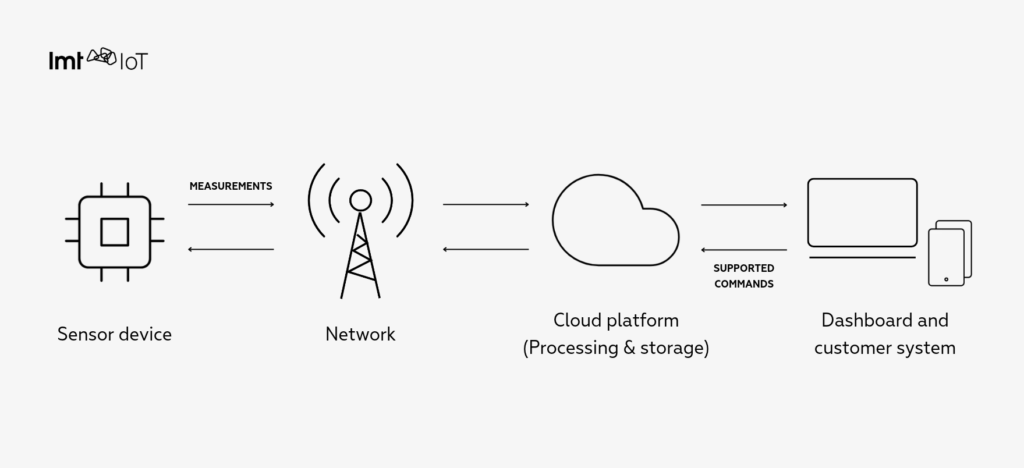
The data flow through IoT cloud platforms starts at the device level. Sensors collect measurements, while device firmware determines when to read, process and transmit them.
- The device sends data. A cellular connection, local network or gateway carries measurements to the cloud. Network connectivity and cloud software have separate roles.
- The cloud service receives the message. It checks the device identity and accepts data through a supported communication protocol, such as MQTT, HTTPS or CoAP.
- The data is processed and stored. Configured rules can validate, filter or route measurements to storage, alerts or other services.
- People and systems use the information. Dashboards display readings and trends. APIs and webhooks connect data or events with business applications.
- Supported commands return to the device. The platform may send a configuration change or update request. Device firmware executes it when the device is reachable and able to respond.
For example, a temperature sensor can send a reading from a storage facility. A configured threshold rule can then notify the responsible team. The sensor measures temperature, the cloud service processes the message and triggers the notification.
Main platform functions
Platforms combine these functions in different ways. Check which are included and which require additional services or development.
| Function | What it enables |
|---|---|
| Device management | Register devices, track status and firmware versions, and manage configuration or updates. |
| Monitoring | View incoming measurements, identify missing reports and receive configured alerts. |
| Data processing and storage | Decode payloads, organise measurements and retain data for later use. |
| Analytics | Compare historical readings, identify trends and feed specialist analysis tools. |
| Remote control | Request supported actions, such as a restart or settings change, and track the result. |
| Integration and access | Connect other systems through APIs or webhooks and control who can access data and functions. |
Benefits and challenges
Cloud platforms give your team a central place to monitor distributed devices. They can provide shared storage and processing resources, while APIs let different applications use the same device data. This flexibility supports changes to reporting and workflows as a deployment develops.
Plan for the following tradeoffs:
- Scalability: confirm device, message and storage limits before moving from a pilot to a larger fleet. More frequent reporting increases both workload and cost.
- Security: assess device identities, encrypted communication, access permissions, updates and monitoring. Security depends on the device, network, cloud configuration and operating practices together.
- Latency: reporting intervals, network conditions and processing add delay. Time-critical control may need to run on the device or a local gateway.
- Vendor lock-in: proprietary data models, firmware dependencies and integrations can make migration harder. Check data export, API access and the work needed to move to another service.
- Ongoing costs: include connectivity, message processing, storage, integration and support when comparing operating costs.
Where are IoT cloud platforms used?
The platform functions are similar across industries, but the measurements and response requirements differ.
- Manufacturing: collect equipment temperature, vibration or operating-status data to support maintenance planning.
- Smart cities: monitor water levels, parking occupancy or infrastructure status across multiple locations.
- Healthcare: collect readings from suitable connected monitoring devices and make them available to authorised systems and staff.
- Logistics: combine asset location with condition data, such as temperature during transport.
- Agriculture: monitor soil moisture and weather conditions to support irrigation decisions.
Real-time asset tracking
For asset tracking, the device determines its location using GNSS or another positioning method and sends an update over an available network. The cloud platform stores timestamped positions and makes them available to maps, alerts or logistics software.
Define how fresh a location must be before choosing a solution. A tracker reporting every few minutes supports a different task from one reporting every few seconds. Test positioning accuracy, coverage, battery use, delayed uploads and how clearly the interface identifies an old position.
Understanding the IoT cloud platform market
The IoT cloud platform market includes services with different levels of engineering responsibility. A useful comparison starts with what your team needs to build and operate.
| Offering | Typical starting point | Your team should assess |
|---|---|---|
| Cloud building blocks | Messaging, identity and processing services for a custom solution | Development capacity, service configuration and ongoing operations |
| Managed IoT platform | Device management, dashboards and integration tools | Device compatibility, available functions and customisation limits |
| Industry-specific solution | Workflows designed for a defined task or sector | Fit with your use case, data model and existing systems |
These categories overlap. Compare the complete workflow from device onboarding to data export, rather than relying on a feature count. A pilot should test your actual devices, expected message volumes, alert delivery and integration with the systems your team already uses.
Cloud and device management with LMT
For devices built with IoT Shortcut, LMT IoT cloud services receive, process and store device data. Your team can view it in the IoT device management platform or integrate it into your own system through APIs and webhooks.
The platform supports device monitoring and remote management. The device, firmware and project configuration determine the measurements and actions available.
FAQ
IoT cloud platforms connect device data with monitoring and business workflows. They can help your team manage a fleet, retain measurements, set alerts and provide information to other systems. The included functions differ between services.
General cloud hosting provides computing, storage and networking resources. IoT cloud platforms add device-focused functions, such as device identities, telemetry ingestion and fleet management. Some provide a ready interface; others supply building blocks your team combines into a solution.
Compare offerings in the IoT cloud platform market against your devices, data volumes and operating needs. Check onboarding, supported protocols, security controls, integration, export options and long-term support. Estimate the cost of the complete solution at both pilot and rollout scale.
Suitable IoT cloud platforms need to accept timestamped location data and make it available to tracking software at the required update rate. Check mapping or integration options, alert rules, data history and delayed-message handling. Validate the complete tracker-to-screen delay with your hardware and deployment network.
A platform cannot deliver an immediate command to a device without a working communication path. Some services retain a desired state or pending action until the device reconnects. Check how the platform and firmware handle reconnection, command expiry and confirmation.