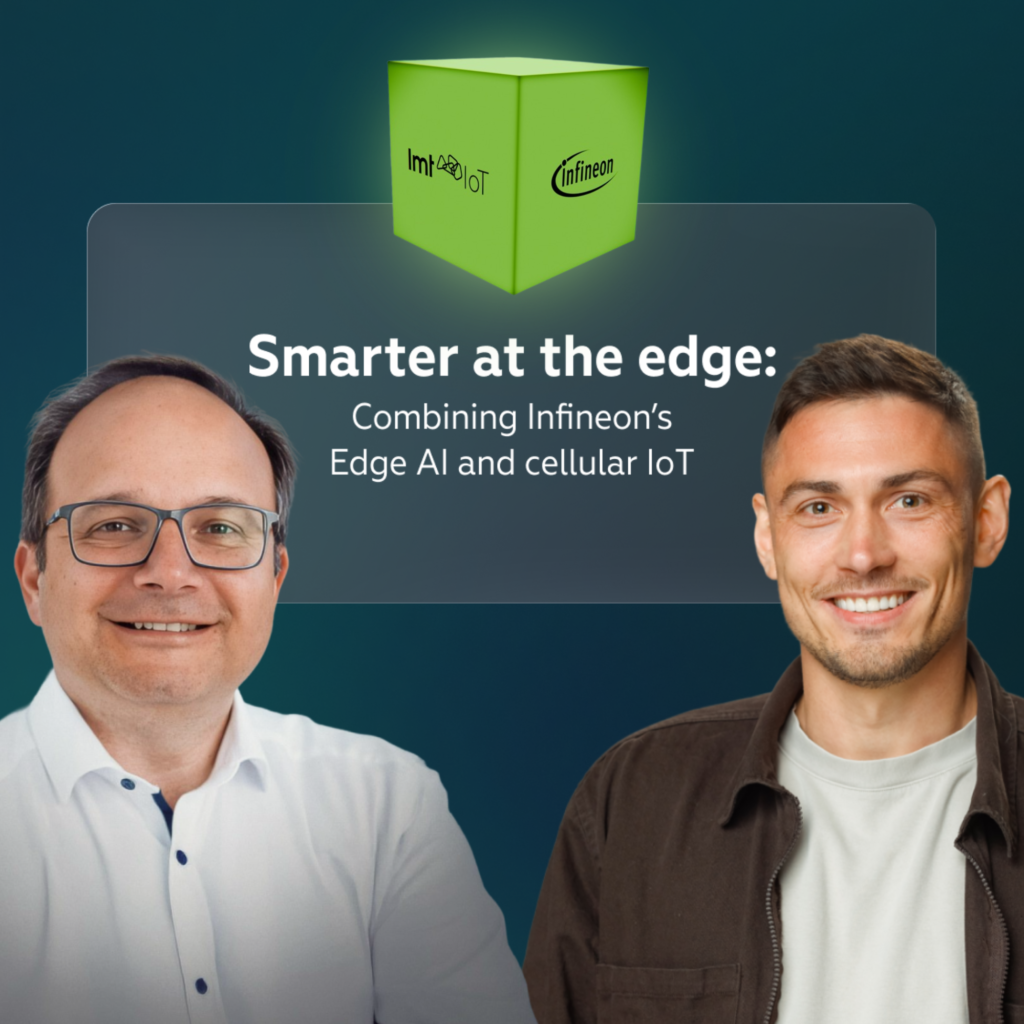



Webinar: Smarter at the edge: Combining Edge AI and cellular IoT
Produced by LMT IoT
Speakers
Annija Frīdenberga, Head of Operations at LMT IoT
Arturs Lalovs, Head of IoT Business Unit at LMT IoT
Andreas Muehlberger, Strategic Partner Manager at Infineon Technologies
What is this webinar about?
This webinar explores what becomes possible when a device can analyse information locally and communicate the results over a cellular network.
Andreas Muehlberger introduces Infineon’s Edge AI tools and hardware. Arturs Lalovs explains how IoT Shortcut can add cellular connectivity and cloud access to connected products. Together, they discuss when these technologies make sense in the same device, using examples from animal well-being, railway monitoring, and remote sensing.
The webinar also covers the LMT IoT and Infineon mentorship program for companies developing low-power cellular Edge AI products. The speakers answer practical questions about who can apply, what support is available, and how a project gets started.
Who are the speakers in this webinar?
The webinar is moderated by Annija Frīdenberga, Head of Operations at LMT IoT.
Arturs Lalovs is the Head of IoT Business Unit at LMT IoT. He works closely with companies developing connected products and is involved in bringing LMT IoT’s hardware, connectivity, software, and cloud capabilities together.
Andreas Muehlberger is a Strategic Partner Manager at Infineon Technologies. Based in Austria, he works with research organisations, universities, startups, and other partners. His background includes product and embedded software development.
What is Edge AI?
Edge AI means running an AI model on a device close to where the data is collected, rather than sending all the raw data to a cloud service for analysis.
For example, a device with a microphone could analyse sounds locally and identify an event that needs attention. It could then send information about that event instead of continuously transmitting audio.
The right approach depends on the product. Some applications need detailed data in the cloud, while others can make useful decisions on the device itself.
Why process data on the device?
Processing data locally can help a device respond quickly, even when sending data to the cloud would introduce a delay. It can also reduce how much information needs to leave the device.
This matters when a sensor produces large amounts of audio, video, or other continuous data. Rather than transmitting the complete stream, an Edge AI model can identify a relevant event and send a smaller message.
As Andreas explains in the webinar, local processing can also help with data privacy because information that remains on the device does not need to be transmitted to the cloud. The overall benefit depends on how the complete product is designed.
Does Edge AI replace the cloud?
No. Edge AI and the cloud can perform different jobs within the same product.
A device can analyse sensor data locally to decide what is relevant. Connectivity then allows it to report an event, make information available to a user, or receive an update.
The cloud can still be useful for device management, presenting information, integrating with other systems, and supporting the product after deployment. The question is which work should happen on the device and which work should happen elsewhere.
Why combine Edge AI with cellular IoT?
Edge AI helps a device interpret what its sensors detect. Cellular connectivity gives it a way to share the result when Wi-Fi or Bluetooth is unavailable or unsuitable.
Consider a sensor installed along a railway line. It may need to listen for an unusual sound, but transmitting continuous audio would create a large amount of data. Local analysis could identify an anomaly, while cellular connectivity could deliver the relevant event to the people responsible for investigating it.
The combination is especially useful when a device is remote, battery-powered, or expected to report selected events instead of a continuous stream of raw data.
Does every Edge AI device need cellular connectivity?
No. The choice depends on where the product will be used and what it needs to communicate.
For a device that always operates within range of a suitable local network, Wi-Fi or Bluetooth may be sufficient. Some applications can also perform their task locally without communicating regularly.
Cellular connectivity becomes relevant when the device needs to report information from places where a local network cannot be relied on, or when it needs a way to stay connected after it has been deployed.
Does every cellular IoT device need Edge AI?
No. Many connected products only need to measure a value and send it at suitable intervals.
Edge AI becomes useful when a simple measurement does not provide enough information. A product might need to distinguish between different sounds, recognise an object, or identify a pattern before deciding whether an event is worth reporting.
Arturs emphasises that the product’s use case should determine whether both technologies are needed.
What does Infineon contribute to an Edge AI product?
Infineon provides microcontrollers, development boards, sensors, software tools, and support for developing models that run on the device.
In the webinar, Andreas introduces Infineon’s DEEPCRAFT offering. It includes tools for creating, preparing, optimising, and deploying AI models on compatible Infineon hardware. He also discusses ready-made models and evaluation kits that teams can use to explore applications before developing a finished product.
These tools help developers test whether local analysis can perform the task their product requires.
What is Infineon DEEPCRAFT Studio?
DEEPCRAFT Studio is a tool for developing Edge AI models for Infineon hardware.
Andreas describes a workflow in which a team collects data, develops and optimises a model, then tests it on a microcontroller. The available development boards can support different types of input, including sound, motion, radar, and images, depending on the kit.
Testing on the intended hardware matters because a model also has to fit the device’s processing, memory, and power limits.
Can a team use an AI model it has already developed?
Andreas explains that Infineon’s model conversion tools can help teams prepare existing models for execution on supported microcontrollers.
The conversion process focuses on making the model suitable for the hardware, including its performance and memory requirements. This gives teams with an existing model a route to test how it performs on an embedded device.
The suitability of a particular model still needs to be evaluated against the product’s requirements and chosen hardware.
What does IoT Shortcut add to the product?
IoT Shortcut provides a foundation for developing a low-power cellular IoT product. It brings together a System on Module, firmware development tools, connectivity, and integration with LMT IoT’s cloud and device management platform.
Arturs explains that LMT IoT developed IoT Shortcut after encountering how much work it takes to build cellular connectivity into a product. Choosing hardware, developing firmware, setting up communication, and connecting a device to the cloud are challenges that recur across different products.
With these layers already brought together, a company can focus more of its development effort on its sensors, product logic, and use case.
How can Infineon technology and IoT Shortcut work together?
An Infineon microcontroller can run the local sensing and Edge AI functions. IoT Shortcut can provide the cellular connection used to send relevant information to the cloud.
Arturs describes an extension board developed for Infineon evaluation kits to help teams explore this combination during prototyping.
In a finished product, the architecture depends on the application. The important design decision is what the device should analyse locally, what it should transmit, and how it will be maintained after deployment.
Why does sending fewer events matter for a battery-powered device?
Transmitting data uses energy. If a device collects continuous audio or video, sending all of it can place substantial demands on its power budget and connectivity.
Local analysis offers another approach: the device processes the stream and sends information when it detects something relevant.
This does not mean that adding Edge AI will automatically increase battery life. The model also consumes energy when it runs. Developers need to evaluate the complete operating profile, including sensing, processing, cellular communication, and time spent in low-power states.
Why is two-way connectivity useful for an Edge AI device?
An Edge AI product may need attention after it has been deployed. A team might discover new examples that its model should recognise or decide to improve how the device responds to an event.
As Arturs explains, connectivity can support more than sending an alert. It can also provide a path for maintaining and updating a deployed product.
How those updates are implemented depends on the device architecture. Planning for maintenance early is particularly valuable when devices will be installed in remote or difficult-to-access locations.
How could Edge AI and cellular IoT help monitor railway infrastructure?
Arturs discusses an example in which sound from a moving train is analysed for signs of a railway anomaly.
One approach would be to send the audio to the cloud for analysis. That could mean transferring a large volume of raw data. With local analysis, the device could instead identify a relevant sound and use cellular connectivity to report the event.
The example shows how the two technologies can divide the work: Edge AI interprets the sound, and connectivity makes the finding available to the people who need to act on it.
How could the technologies be used in an animal well-being product?
Andreas describes a company developing a connected dog collar. Its goal is to analyse aspects of a dog’s behaviour and make useful information available to the owner.
The product is an example of a task that involves both interpretation and communication. Local processing can help analyse signals from the device, while connectivity can help share the resulting information with an application.
Andreas explains that the company has been developing its own hardware with support from Infineon and LMT IoT.
Are there other applications for remote Edge AI devices?
The speakers discuss several possible applications involving sound and images.
For example, a remote monitoring device could analyse a sound locally and report a detected event. Arturs also describes the idea of a camera that identifies an object on the device and sends a short notification when the available connection can carry only a small amount of data.
These examples illustrate a common design question: can the product extract the information someone needs at the edge, then communicate that information efficiently?
What is the LMT IoT and Infineon mentorship program?
The mentorship program supports companies developing products that could benefit from combining Edge AI with low-power cellular connectivity.
Participants can gain access to evaluation hardware and relevant technical expertise from LMT IoT and Infineon. The aim is to help teams test a use case, build a working prototype, and learn from its performance in real conditions.
The speakers describe it as a practical collaboration shaped around the needs of each participating team.
Who is the mentorship program for?
The program is relevant to startups and other companies with a product idea that could use Edge AI and cellular IoT together.
A smaller team may benefit because it does not have specialists in every area of embedded development, AI, cellular connectivity, and cloud systems. Arturs adds that a larger company developing a new product line may also be a good fit if it needs support with these technologies.
The most useful starting point is a specific problem the team wants its product to solve.
Does a company need a finished prototype before applying?
No. During the audience Q&A, the speakers explain that a finished product is not required.
An early prototype can be enough, and a team with a strong idea and relevant development skills may also be suitable. The initial discussion helps determine whether the proposed application is a good fit for the available technologies and support.
What support can participating teams expect?
The support depends on the technical questions and development stage of the project.
The speakers discuss access to evaluation kits, guidance on the technologies, and contact with relevant engineers when a team needs help. Infineon’s startup collaboration work can also help connect a company with specialists within its organisation.
The participating company remains responsible for driving its product development. The mentors help the team work through specific challenges and move towards an agreed prototype or trial.
Is there a set time commitment for the mentorship program?
The speakers do not specify a fixed number of hours that every participating company must commit.
Instead, the commitment depends on the team’s goals and how quickly it wants to develop the product. Andreas explains that the parties would typically agree on a first tangible result, such as a prototype or trial, and a timeline for reaching it.
A team should therefore be ready to devote time to building and testing its idea, even though the precise schedule is set around the project.
Are there fees to join the mentorship program?
Arturs states in the webinar that there are no program fees. The commitment the speakers emphasise is the team’s active involvement in developing its product and working towards agreed milestones.
Companies interested in participating can discuss the scope of their proposed project with LMT IoT and Infineon.
Can a company apply if it already has hardware or a cloud platform?
Possibly. The speakers explain that an existing architecture is worth discussing.
Whether the mentorship program is a good fit depends on the product, the technologies it already uses, and where Infineon’s and LMT IoT’s components could add value. The team may need only part of the available technology, or it may decide to adjust its design.
An initial conversation can help identify a useful integration path.
What happens after a company applies?
The first step is a conversation about the company’s idea and use case. Technical colleagues may join to help assess whether the proposed product is a good match for the technologies.
If there is a fit, the teams can discuss suitable evaluation hardware, identify the first development goals, and agree on a timeline for a prototype.
Arturs encourages companies to start with that discussion, even if they are still deciding which technical approach their product needs.
Can the partners help when a prototype is ready to scale?
Andreas explains that Infineon can help connect developing companies with its distribution channels and, where relevant, sales and marketing contacts. These relationships can become useful when a product moves beyond a small number of prototypes and needs a reliable route to larger component quantities.
The support available after prototyping depends on the project and the relationship that develops. The webinar presents the first working prototype and real-world feedback as important steps towards that later stage.
What is the main takeaway from the webinar?
Edge AI and cellular connectivity solve different parts of a connected-product problem.
Edge AI can help a device interpret sensor data where it is collected. Cellular connectivity can help it report useful results and remain connected after deployment. Together, they can enable products that need to make sense of their surroundings in places where a local network is not available.
The best architecture still depends on the use case: what the device needs to detect, how quickly it must respond, how much data it should send, how it is powered, and how it will be maintained throughout its lifetime.