
IoT connectivity: How to choose the right network for your use case
IoT connectivity isn’t just about linking devices. It’s about keeping them truly connected – reliably, securely, and without draining power or budgets. And with billions of devices now online worldwide, that challenge is only growing. According to IoT Analytics, the number of connected IoT devices reached 18.8 billion in 2024, with forecasts exceeding 40 billion by 2030.
There are, in fact, many IoT connectivity types to choose from, making questions like “Which one is best?” and “Which one fits what I’m building?” relevant to anyone building IoT products. Each connectivity option was created for a different kind of job, and understanding those differences makes choosing far simpler.
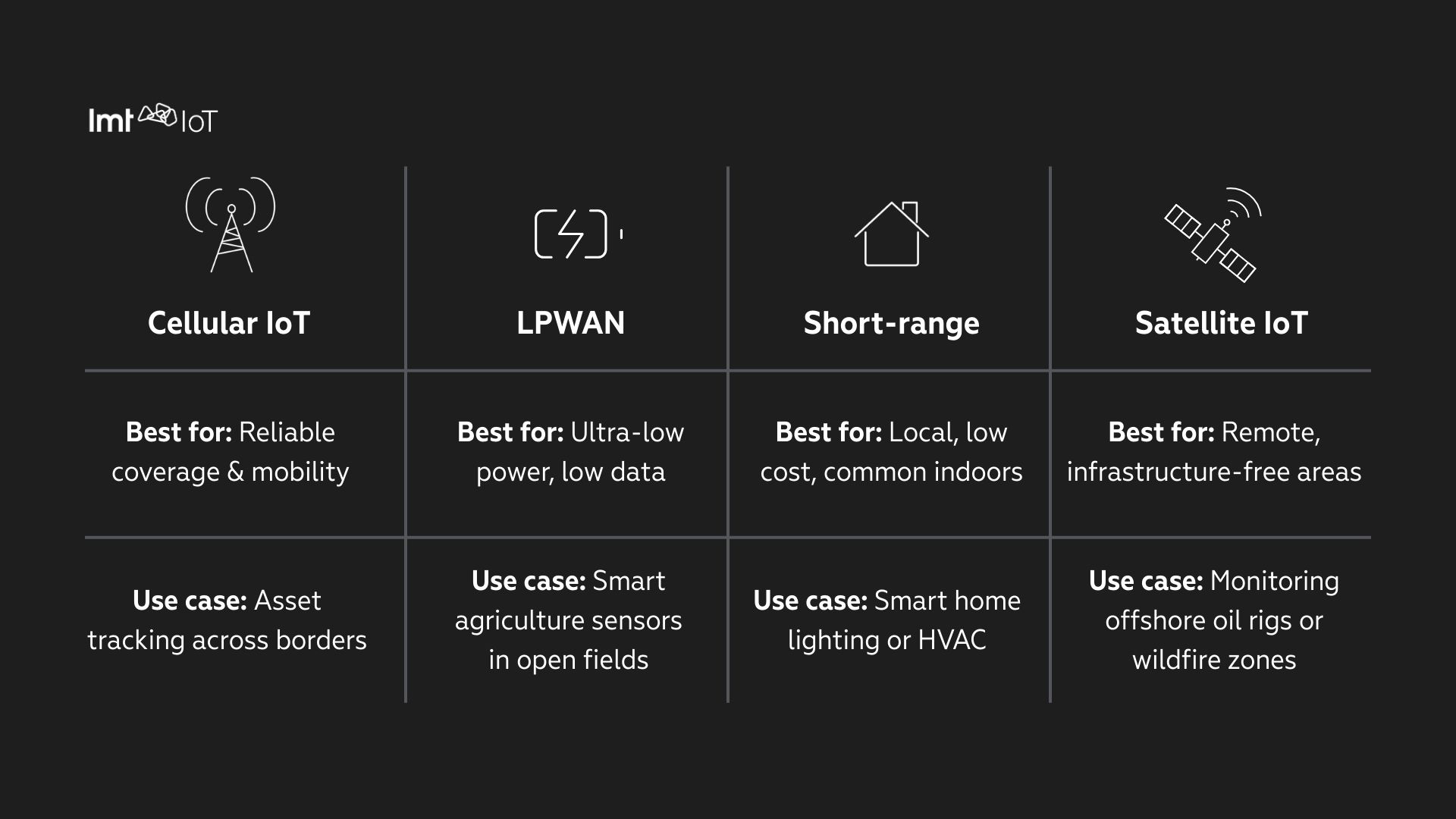
In this article, we explore four IoT connectivity types – Cellular IoT, LPWAN, short-range networks, and satellite IoT – and their pros and cons, giving you a clearer foundation for choosing the right one for what you’re building
1. Cellular IoT (LTE-M, NB-IoT, Cat-1/4, 5G mMTC)
Cellular IoT is one of the most widely adopted IoT communication technologies, especially in projects where uptime and coverage matter most. It uses licensed mobile networks to keep devices online reliably and securely. Hence, cellular IoT is a strong fit for smart buildings, utilities, safety devices, mobile tracking, and industrial monitoring, where uptime and coverage matter more than anything else.
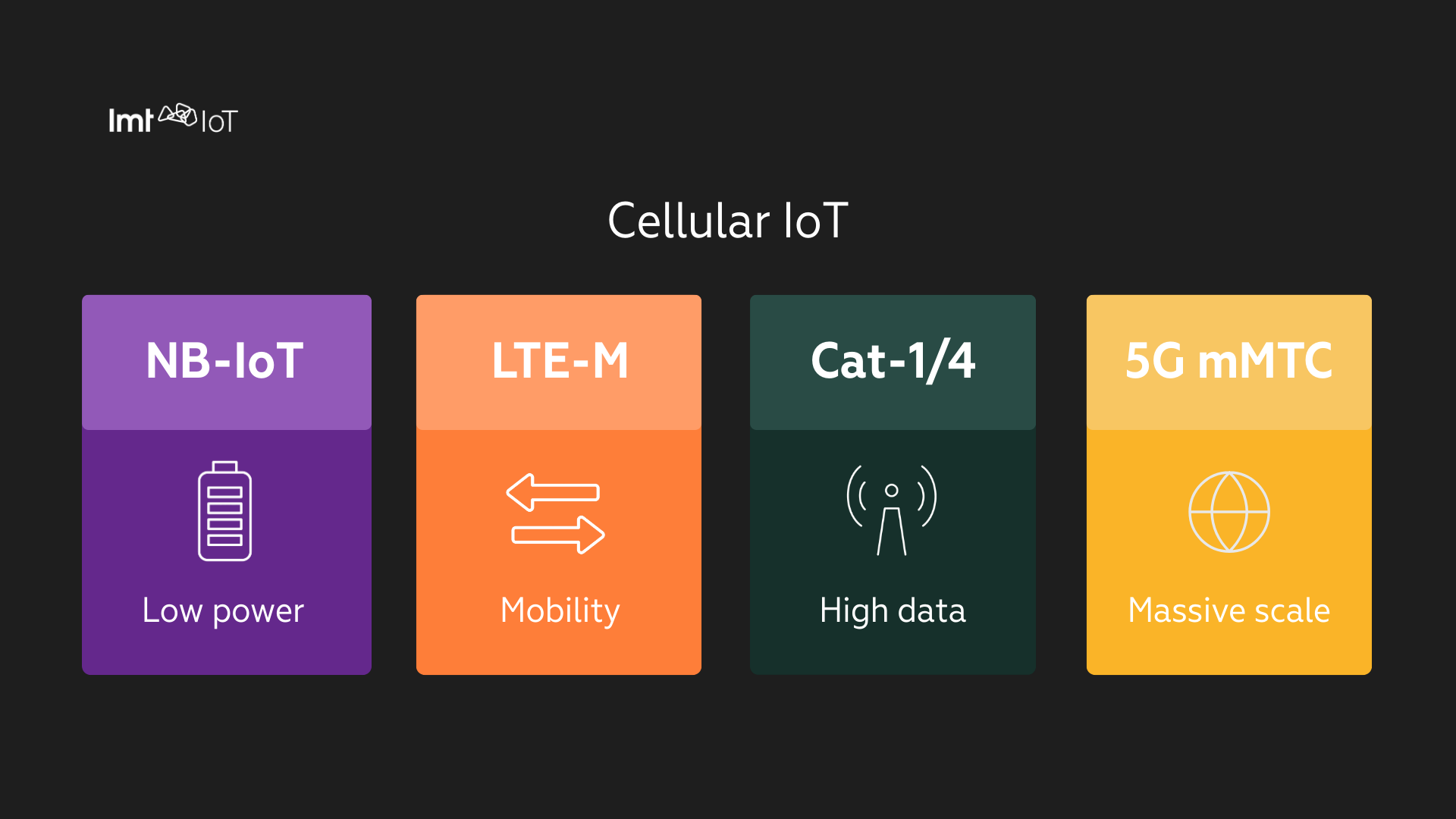
Cellular IoT is an umbrella term, and the technologies inside it serve very different purposes. Here’s a concise overview of what each technology is:
- NB-IoT: A low-power network built for stationary devices that send small amounts of data. It reaches deep indoors, uses very little energy, and can power sensors for years without maintenance.
- LTE-M: Designed for mobility and real-time communication. LTE-M supports movement, handovers, and voice, making it ideal for asset tracking and wearable or portable devices.
- LTE Cat-1 / Cat-4: Higher-bandwidth 4G options for devices that need more data, such as cameras, POS terminals, or vehicle systems.
- 5G mMTC: A 5G feature that supports extremely dense sensor deployments. It’s still rolling out, but it’s shaping the future for large-scale industrial IoT.
Side note: The lowest-power options, NB-IoT and LTE-M (often called Cellular LPWAN or Mobile IoT), are designed specifically for battery-powered sensor devices.
Pros of cellular IoT
Cellular IoT offers several advantages, making it a reliable choice for real-world deployments, especially when devices need to stay connected without oversight. Here’s what sets it apart:
- Wide-area coverage: Cellular IoT reaches deep indoors, across cities, and far into rural regions without requiring gateways or private infrastructure. Devices connect wherever the network exists.
- Strong, SIM-based security: Every connection is authenticated through a SIM or embedded SIM, creating a hardware root of trust that meets modern security expectations.
- Reliable connectivity, even at scale: Networks like NB-IoT and LTE-M are engineered for massive deployments with predictable latency and excellent penetration. For mobile use cases, LTE-M supports handovers and mobility without session drops.
- Multi-year battery life with NB-IoT: Although cellular has historically been seen as power-hungry, NB-IoT changed the equation. With deep-sleep modes and infrequent transmissions, devices can run for several years, even in challenging environments.
- Designed for mobility: LTE-M supports roaming and movement, making it a strong fit for tracking vehicles, tools, or high-value assets that rarely stay in one place.
Trade-offs to consider
While cellular IoT offers strong reliability and security, there are a few considerations to keep in mind when choosing it for your deployment. These aren’t drawbacks as much as reminders to match the technology to the task:
- Requires a subscription: Cellular IoT runs on mobile operator networks, which means every device needs a SIM profile and an active data plan. For large fleets, this becomes part of the operating cost structure.
- Higher power consumption for frequent transmissions: NB-IoT and LTE-M are highly efficient when devices send data occasionally. But if your use case requires very frequent messaging, power usage increases compared to other options.
- Dependent on operator coverage: Cellular IoT goes wherever licensed networks exist, but if a device is deployed in an area with no LTE-M or NB-IoT availability, alternative connectivity may be required.
- More complex radio stack than short-range networks: Cellular radios offer powerful features but are more complex than technologies like BLE or Wi-Fi.
Conclusion: Cellular IoT is the right choice when coverage, security, and dependable uptime matter. With SIM-based authentication and nationwide networks, it keeps devices connected without extra infrastructure – a solid foundation for long-term, real-world deployments. It’s often the best IoT network for sensors and devices that need reliable, always-on connectivity.
2. LPWAN (Low-Power Wide-Area Networks, unlicensed spectrum) – a key IoT connectivity type
LPWAN technologies are designed for devices that need to send small amounts of data over long distances while consuming as little energy as possible. Unlike cellular IoT, these networks operate in unlicensed spectrum, making them affordable and easy to deploy. They’re commonly used in agriculture, environmental monitoring, smart utilities, and simple indoor sensors where extended battery life and low cost take priority over bandwidth or mobility.
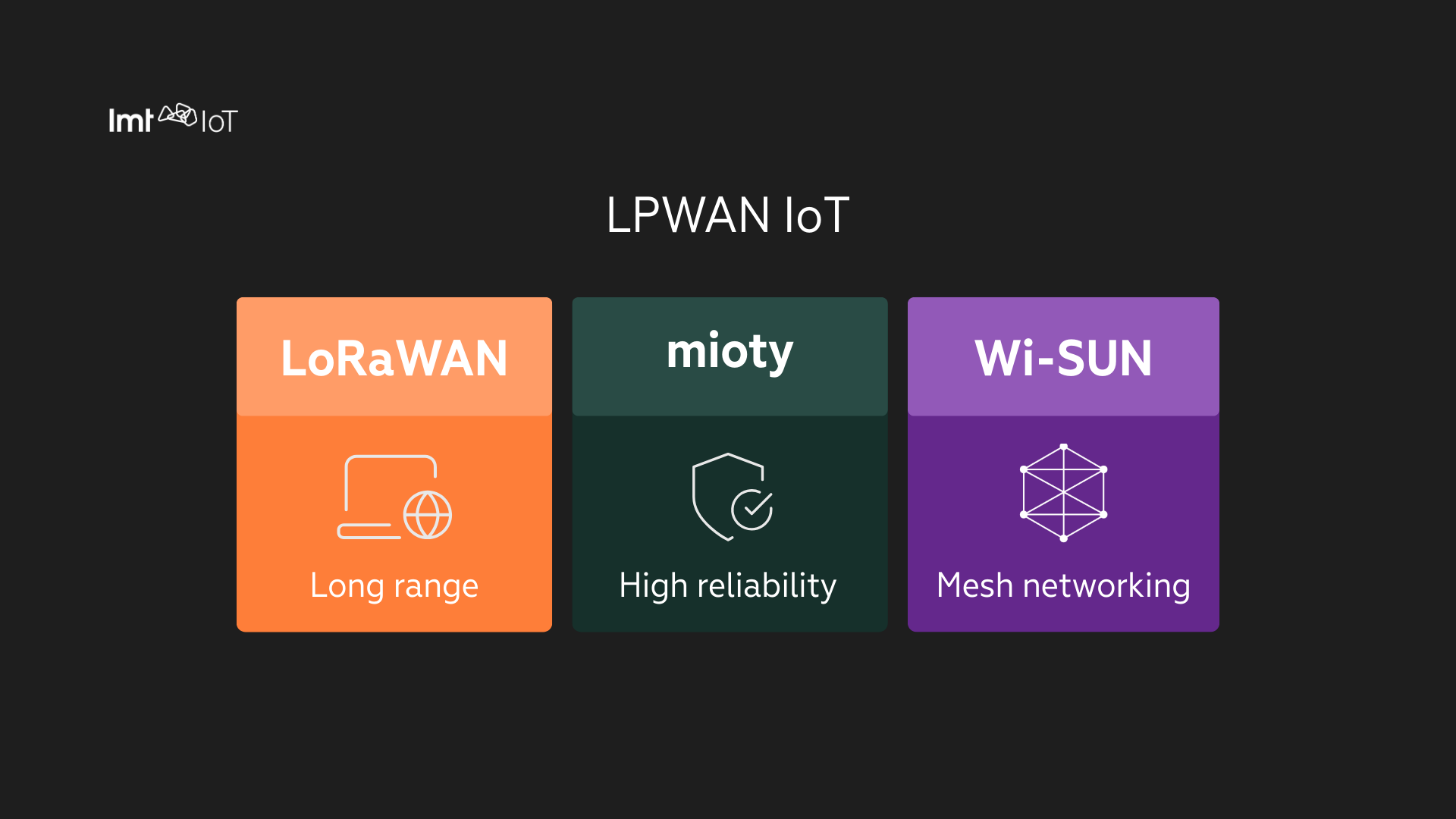
LPWAN isn’t a single technology – it’s a category. Each network behaves differently, and understanding its strengths helps you choose. Here’s what each LPWAN technology is:
- LoRaWAN is a widely adopted LPWAN standard with a global ecosystem, offering long-range connectivity of roughly 5 km in urban areas and up to 15 km in open environments. It delivers extremely low power consumption and can be deployed easily using either public or private gateways. Because of this flexibility, LoRaWAN is commonly used in agriculture, smart metering, and community-based networks.
- mioty is a newer LPWAN protocol built for resilience in noisy radio environments. It uses Telegram Splitting (TSMA) to maintain reliability even in congested spectrum and is excellent for large-scale sensor networks and mobile IoT. mioty’s ecosystem is growing, but it’s still less mature than LoRaWAN. However, it’s a good match for industrial-scale sensing where message integrity is critical.
- Wi-SUN is engineered for high-performance communication in smart grid environments. It employs a mesh topology, meaning the network is decentralized and self-managing, ensuring reliability even over expansive service areas. This proven standard is widely adopted by energy companies because it provides necessary interoperability and is specifically optimized for large-scale, resilient infrastructure.
Pros of LPWAN
LPWAN technologies are built around simplicity and efficiency, making them a practical choice for devices that don’t require high bandwidth or constant mobility. They shine in deployments where the goal is to collect small bursts of data reliably, without adding cost or complexity. Here’s what makes them appealing:
- Very low cost: LPWAN hardware is affordable, and because these networks operate in unlicensed spectrum, organizations can deploy their own infrastructure without recurring operator fees.
- Long battery life: Thanks to ultra-low-power radio profiles, devices can run for years on small batteries. This is especially valuable in remote or hard-to-reach locations, where changing batteries isn’t practical and uninterrupted operation matters.
- Quick to deploy: LPWAN gateways are lightweight and straightforward to install, enabling rapid rollout even in environments where traditional connectivity would be complicated or costly. Whether it’s a rural field, a warehouse, or a temporary site, LPWAN brings connectivity without the usual logistical hurdles.
Trade-offs to consider
LPWAN networks excel at keeping things simple, but that simplicity comes with limits. They’re designed for lightweight communication, not for scenarios where devices need to move freely, send larger payloads, or stay consistently connected in busy radio environments. Here are the key considerations:
- Limited data rates: LPWAN protocols support short, infrequent messages. They work well for small sensor updates but aren’t suited for continuous data streams, real-time communication, or applications that require larger payloads.
- Not ideal for mobility: Most LPWAN deployments rely on stationary gateways, and seamless roaming isn’t typically supported. This makes the technology better suited to fixed installations than to devices that travel across sites or regions.
- Requires gateway infrastructure: While LPWAN can be cost-effective, private deployments still require on-site gateways. Maintaining this infrastructure, especially across multiple locations, adds responsibility for setup, monitoring, and upkeep.
- More variability in reliability: Operating in unlicensed spectrum keeps costs low, but it also means LPWAN can be affected by interference or congestion, particularly in urban or industrial areas where many devices share the same frequencies.
Conclusion: If the objective is to gather reliable data with minimal infrastructure, LPWAN offers a balanced, cost-effective foundation for a wide range of IoT use cases. It’s a practical option when comparing IoT connectivity types for simple, low-data devices.
3. Short-range networks
Short-range wireless technologies are designed for devices that “live” close to a gateway or user. They offer fast, affordable connectivity for homes, offices, and small indoor systems where distance is limited, and data needs are higher. These networks are familiar, widely supported, and ideal for local communication rather than wide-area coverage. Moreover, the short-range options are popular for smart device connectivity in homes, offices, and small commercial spaces.
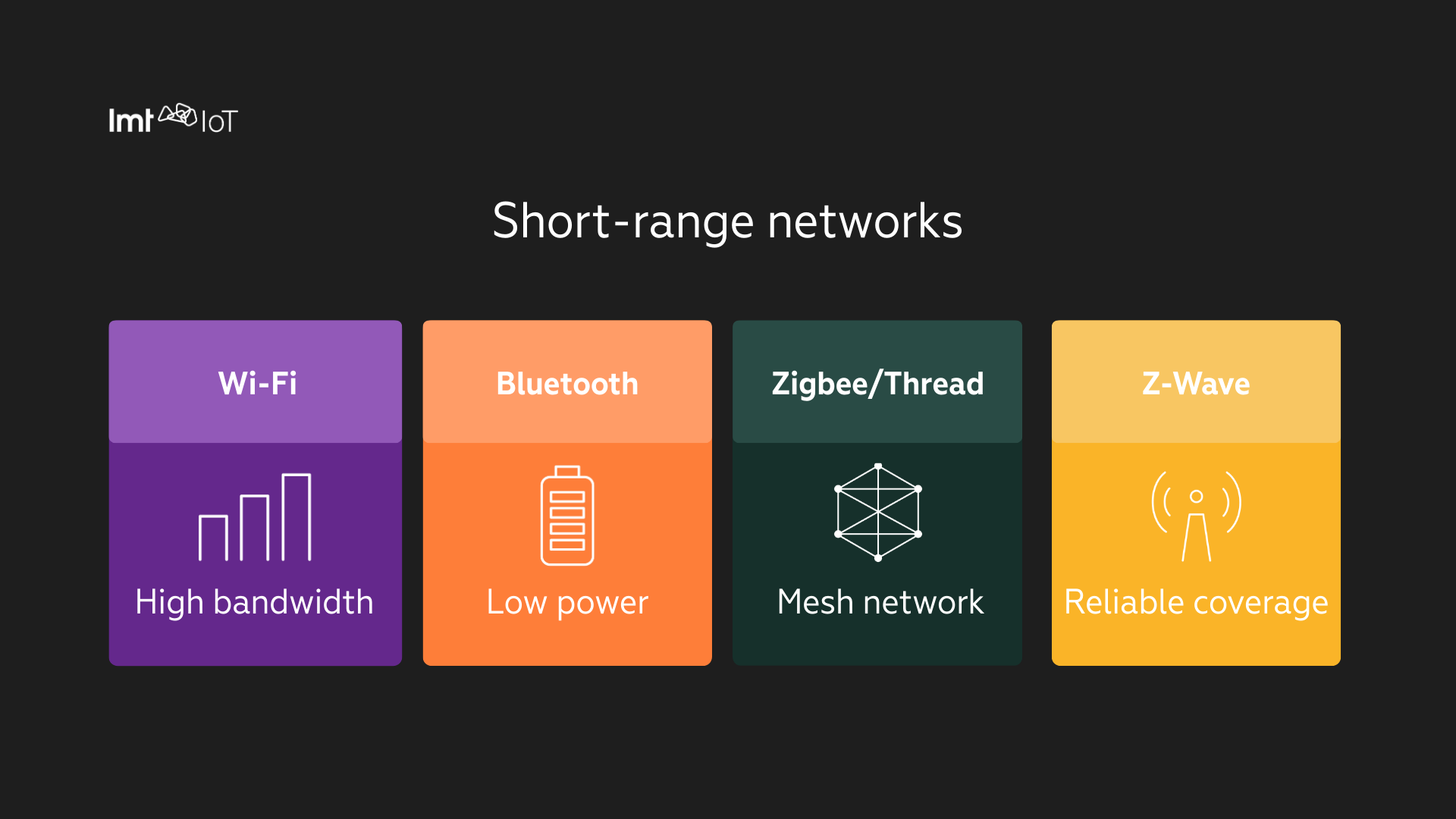
Short-range connectivity covers a variety of technologies, each with its own strengths in everyday environments. Here’s what each short-range technology is and how they differ:
- Wi-Fi (and Wi-Fi HaLow): Wi-Fi is the most familiar indoor connectivity option, offering high data rates suitable for cameras, appliances, and everyday consumer devices. Its typical range is 30–100 meters, depending on walls and interference, making it well-suited for rooms or small buildings. Wi-Fi HaLow extends this range while reducing power consumption, making it more practical for IoT sensors. Overall, Wi-Fi is a strong choice when bandwidth matters more than battery life.
- Bluetooth Low Energy (BLE) is a highly efficient version of standard Bluetooth. It’s used in wearable tech, fitness trackers, and small sensors. Its biggest benefit is using so little power that devices can run for years on a tiny battery. While it only works over short distances, it’s widely supported by almost all smartphones and consumer electronics.
- Zigbee and Thread are the key wireless signals used for connecting gadgets in a smart home or office building. They create a “team network” (mesh network) where every device acts as a relay, passing messages from one to the next to cover the entire space, even across different rooms and floors. They are perfect for controlling things like smart lighting, door locks, and thermostats. Thread is becoming very popular because it works seamlessly with the new Matter standard for smart homes.
- Z-Wave is a wireless technology used in smart homes to control devices such as locks and lighting. Its unique feature is that it uses a special, low-frequency signal (below 1 GHz) that is highly effective at providing reliable indoor coverage throughout a house. It creates a robust mesh network where every device helps carry the signal, guaranteeing great performance and compatibility across all Z-Wave products. This stability makes it popular for professional smart home setups.
Pros of short-range networks
Short-range technologies work well when devices operate close to users or indoor gateways. Their strengths make them a practical option for homes, offices, and small commercial spaces.
- Low cost: Hardware is affordable, and many devices can plug into existing home or office networks without added infrastructure.
- Widely supported: Wi-Fi, BLE, Zigbee, Thread, and Z-Wave all have large ecosystems with strong vendor adoption, making it easy to find compatible devices.
- Mature technology stacks: These protocols have been refined over decades, resulting in stable performance, predictable behavior, and straightforward integration.
A few trade-offs
Short-range connectivity offers convenience, but it comes with limits, especially when scaling beyond a single room or building.
- Limited range: Most radios cover only tens of meters and are easily affected by walls, floors, and other interference.
- Often dependent on gateways: Devices typically need a router, hub, or smartphone nearby to access the internet.
- Not suitable for remote or distributed deployments: Large facilities, campuses, or outdoor environments require technologies designed for long-distance communication.
- Less resilient for mission-critical tasks: Outages or router failures can interrupt service, making short-range networks less reliable for safety or infrastructure monitoring.
Conclusion: Short-range networks are ideal for local, indoor applications that benefit from low cost and broad device support. When the environment is contained and the connectivity path is simple, they provide an efficient and familiar foundation for everyday IoT devices. These technologies are often chosen in smart device connectivity scenarios, where cost and ease of integration matter.
4. Satellite IoT
Satellite IoT is built for the places where no terrestrial network can reach, such as oceans, mountains, deserts, remote farmland, and disaster zones. Analysys Mason reports that satellite IoT connections are growing at over 20% annually, driven by agriculture, energy, and maritime industries.
Instead of relying on cell towers or local gateways, devices communicate directly with satellites orbiting the Earth. This makes satellite connectivity essential for organizations working in remote, high-impact environments where staying offline isn’t an option.
Satellite IoT uses low-Earth-orbit (LEO), medium-orbit (MEO), or geostationary satellites to relay small amounts of data between devices and cloud systems. Modern constellations offer lower latency and lower-cost hardware than traditional satellite systems, making IoT-scale deployments more accessible than ever. Satellite IoT is commonly used in:
- Remote agriculture and environmental monitoring
- Maritime operations and offshore assets
- Mining, forestry, and resource extraction
- Emergency response and disaster recovery
- Global asset tracking
In essence, where distance is the challenge, satellite provides the coverage.
Pros of satellite IoT
Satellite IoT opens doors where terrestrial networks fall short. Its strengths make it indispensable for truly remote or mission-critical deployments.
- Truly global coverage: Devices can connect from virtually anywhere on Earth – even far beyond the reach of cellular or LPWAN networks.
- Independence from local infrastructure: No towers, no gateways, no on-site networking. Devices communicate directly with satellites, which is invaluable for remote operations.
- Resilient in extreme conditions: Satellite networks continue operating during natural disasters or power outages that might disrupt ground-based infrastructure.
Trade-offs to consider
Satellite IoT is powerful, but it’s not the default choice for everyday deployments. Its constraints make it best suited for specific, remote-driven scenarios.
- Higher hardware and service costs: Satellite modules and subscription plans are typically more expensive than cellular or LPWAN options.
- Greater power consumption: Maintaining a link to orbiting satellites requires more energy, making long-term battery operation challenging.
- Lower data rates: Satellite IoT is designed for small telemetry messages – not rich data or frequent communication.
- Line-of-sight requirements: Signals generally need a clear view of the sky, which can be limiting in dense forests, deep indoor settings, or underground environments.
Conclusion: Satellite IoT is the best IoT network for sensors and systems that operate far beyond terrestrial coverage. It delivers dependable global connectivity for remote and mission-critical environments, ensuring that even the most isolated assets can stay visible and connected.
How to choose the best IoT network: A simple framework
Choosing an IoT network doesn’t start with the technology itself – it starts with understanding the real-world conditions your device will operate in. Here are three questions to help shift the focus from technical features to the purpose your device needs to serve, so you can understand which IoT connectivity type is the best fit.
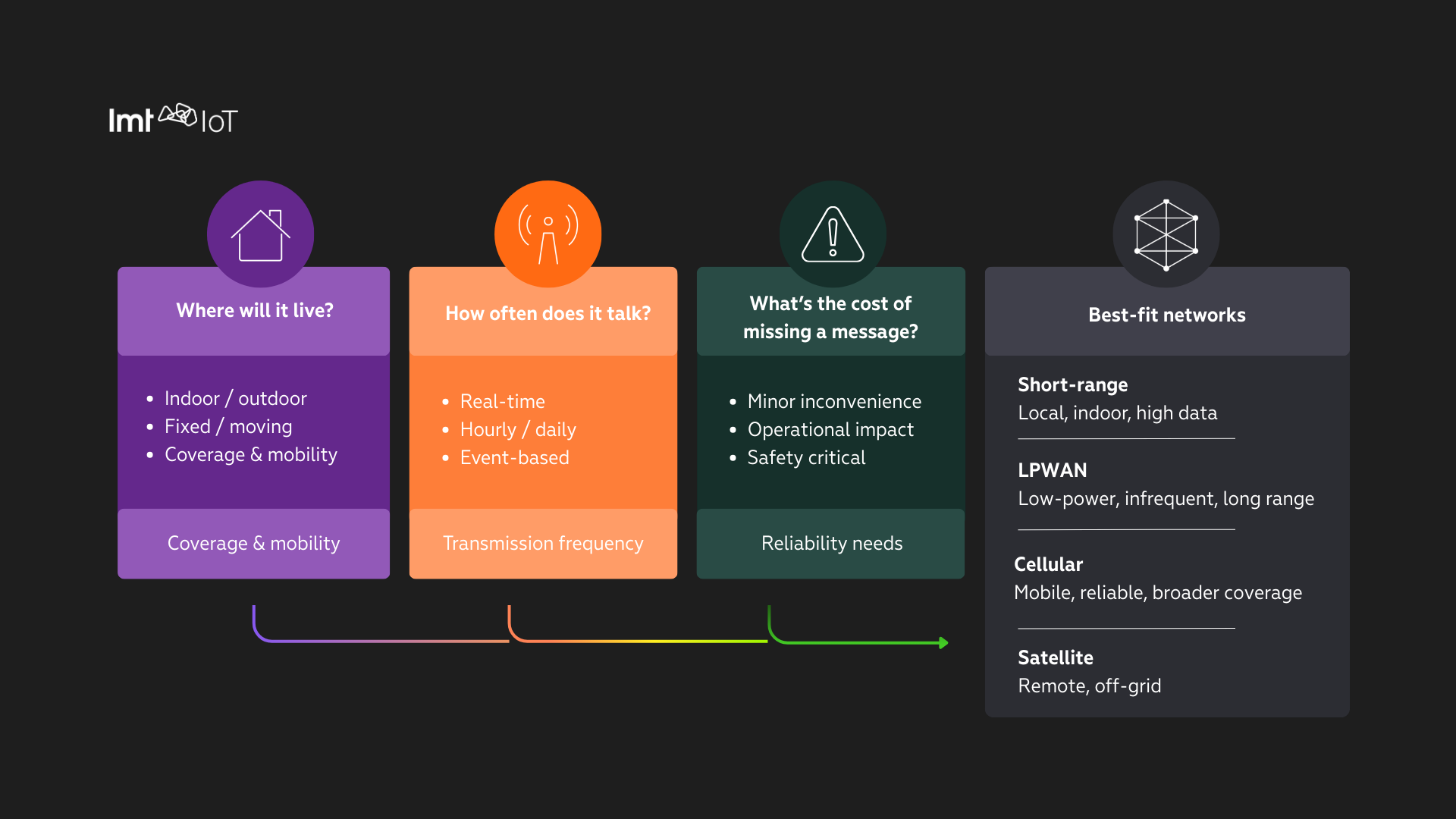
- Where will the device live?
Understanding the physical environment is essential in any IoT network comparison because different networks thrive under different conditions. The physical environment shapes almost every connectivity decision. Is the device indoors or outdoors? Stationary or moving? Will it sit underground, behind concrete walls, or high in a building?
Coverage, penetration, and mobility all depend on where the device spends its life – and this determines whether cellular, LPWAN, short-range, or satellite makes the most sense.
- How often does the device need to talk?
This is one of the most important IoT battery life considerations, especially for devices expected to run for years on a single cell.
Some devices whisper a few times a day; others speak constantly. Does your device need to send data every second, every hour, or only when something important happens? Battery life, bandwidth, and network load all depend on communication patterns, which makes this one of the most important questions to ask early, when deciding on the best-fitting IoT network.
- What’s the cost of missing a message?
Not every use case carries the same weight. Will a missed message cause mild inconvenience, or will it affect safety, compliance, or operational continuity?
This helps distinguish between networks that are “good enough” and those that need the resilience, authentication, and stability of cellular or satellite connectivity. For example, devices such as Aer Smoke rely on cellular precisely because alerts must get through, even during power or Wi-Fi outages.
With these three questions, the choice of network becomes clearer and more intentional. Instead of chasing features, you’re matching the environment, behavior, and risk profile of your device to the technology that supports it best.
There’s no “best” network, only the best fit
Every IoT network is built with a purpose in mind. When you match the technology to the environment, the communication pattern, and the risk of missed messages, you create devices that stay connected, conserve energy, and deliver meaningful results.
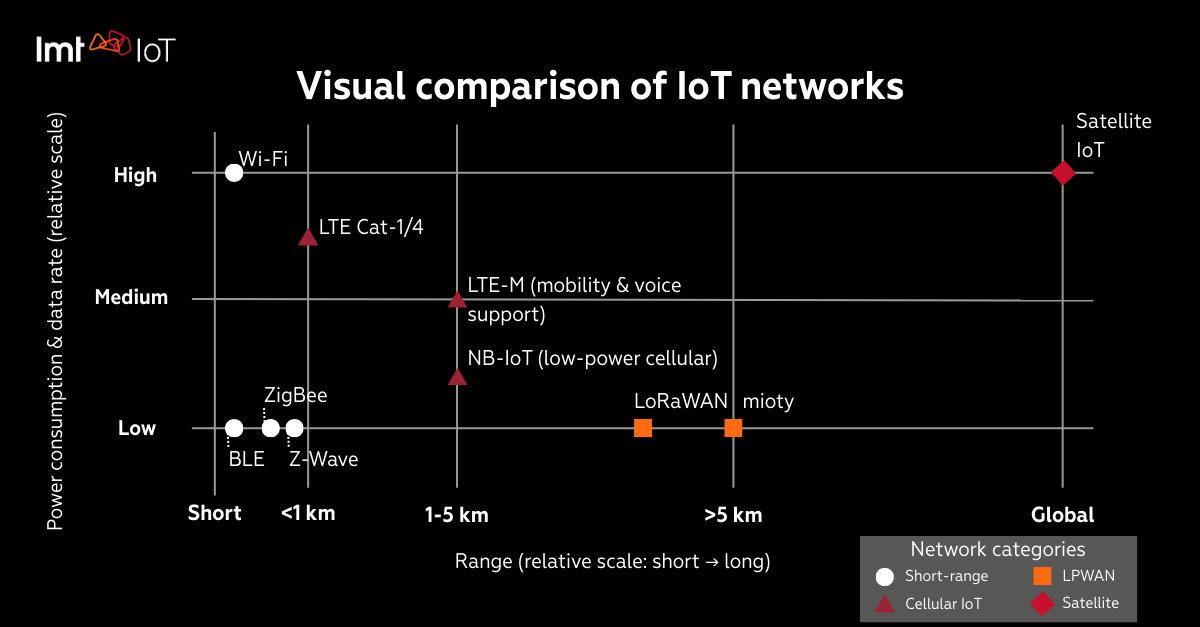
Start by defining what matters most: cost, coverage, or continuity. From there, the right network becomes clear.
Ready to build your next IoT product? With LMT’s IoT Shortcut, you can launch it in months, not years. Book a meeting with us to learn more about what we have to offer for your next IoT business journey!